
A Breton Echo of Guru Nanak
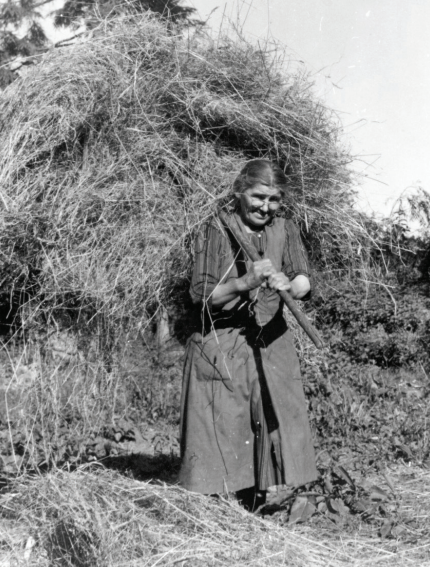
Añjela Duval farming in a small Breton village, Ar C’houerc’had (Le-Vieux-Marché), France, c. 1965. Courtesy of Mignoned Anjela (all rights reserved)
In the mid-twentieth century, Sikh scripture found an unexpected resonance far from Punjab, in the fields and farms of Brittany.
Añjela Duval (1905–1981) was a Breton Catholic farmer, writer, and poet.
In the 1960s, Duval was deeply moved by a French translation of Guru Nanak’s Arti and undertook the remarkable task of translating it into her own Breton language.
Duval was proud of her Breton heritage: that she chose to translate a Sikh hymn into this minority European language speaks to the spiritual and poetic universality she encountered in Guru Nanak’s words.
Her translation opens with the striking line:
“Bolz an neñv a zo da skabell…”
“The sky is the metal tray, the sun and moon are the wick-lights…”
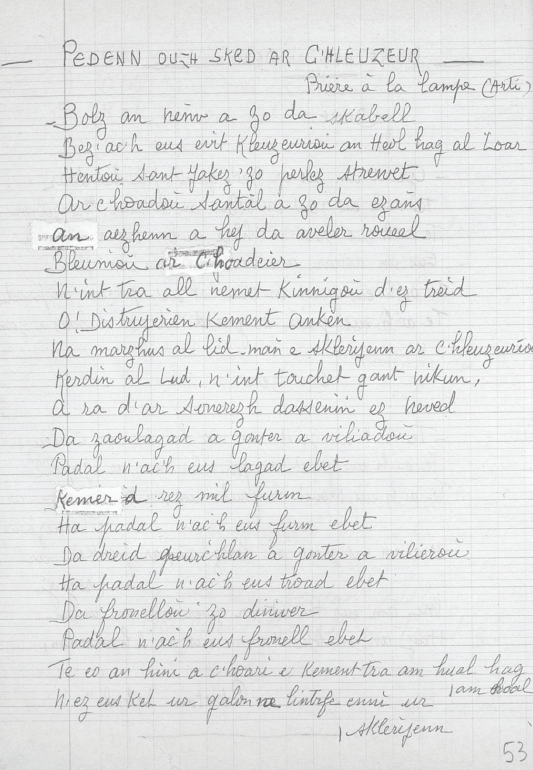
Añjela Duval’s handwritten translation in the Breton language of Guru Nanak’s ‘Arti’ titled ‘Pedenn ouzh sked ar c’hleuzeur’, c. 1965–69. © Kuzul Ar Brezhoneg.
Duval’s work reminds us that Sikh scripture has inspired readers far beyond its place of origin, finding new voices and new meanings in unexpected contexts.
To explore this and other examples of Western women’s encounters with Sikh scripture, see Eleanor Nesbitt’s Sikh: Two Centuries of Western Women’s Art & Writing, available to buy here.