
Textiles and Tradition: Sikh Women’s Creativity

Elisabeth Kozmian with a Punjabi artist, March 1978. Courtesy of Elisabeth Kozmian.
Elisabeth Kozmian (b. 1944) is a Polish-British film-maker and artist who visited Punjab in the spring of 1978 as a member of a cultural study tour.
She documented the artistic and cultural traditions in Punjabi villages and cities in her diary, photography and sound recordings.
In her account, Elizabeth Kozmian offers a rare and attentive record of women’s everyday creativity. It was not rooted not in galleries or markets, but in homes, courtyards, and domestic spaces.
Her observations foreground textile production as a form of artistic expression that was deeply embedded in women’s lives.
Visiting homes across the region, Elisabeth was struck by the ubiquity of textile work.
“We were shown many embroideries and woven rugs,” she noted. “They could be found in almost every house – all women did embroidery and most of them had looms at home.”
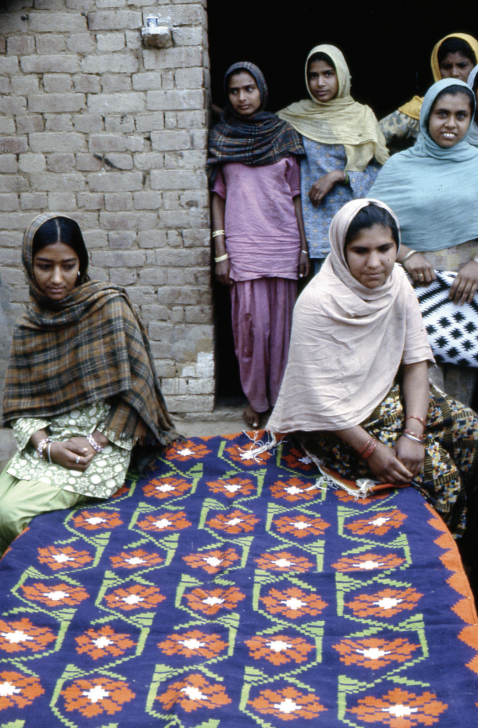
An example of the woven artistry created by Sikh women, Dalla, Punjab, 26–27 March 1978. © Elisabeth Kozmian.
These works were distinguished by their vivid colour palettes and intricate designs, evidence of a shared visual culture sustained through practice rather than formal training.
The women she met acquired their skills from older generations, relying almost entirely on memory rather than drawn patterns. “There were no drawings of patterns,” she observed, describing these works as “astounding achievements.”
Yet the makers themselves rarely claimed the status of artists. Modest and often shy, they understood their talent simply as the continuation of tradition.
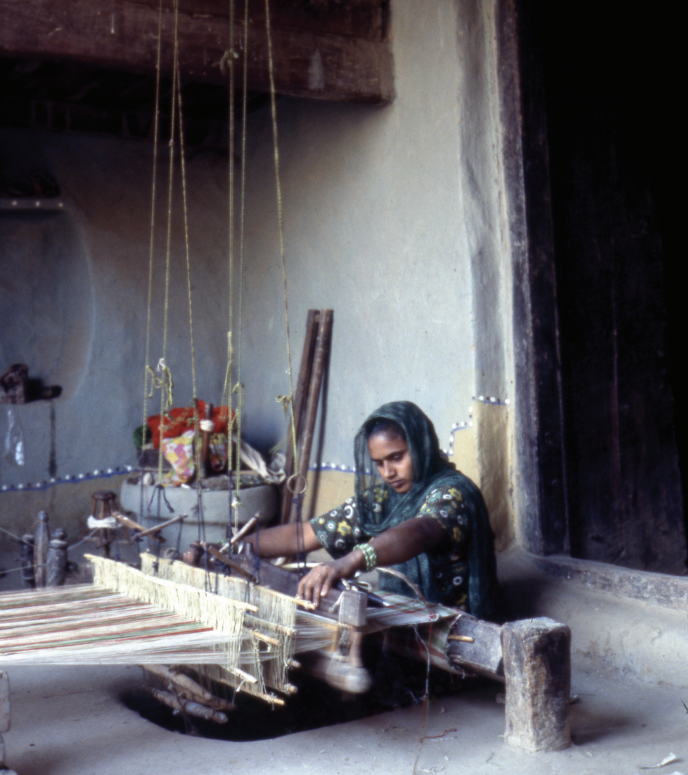
A Sikh lady weaving patterns from memory, Dalla, Punjab, 26–27 March 1978. © Elisabeth Kozmian.
Elisabeth’s account reminds us that Punjabi women’s creativity has long flourished in domestic and communal spaces, sustained through memory, skill, and shared tradition.
See more of her photographs and writings in Eleanor Nesbitt’s ‘Sikh: Two Centuries of Western Women’s Art & Writing’, which you can buy here.